


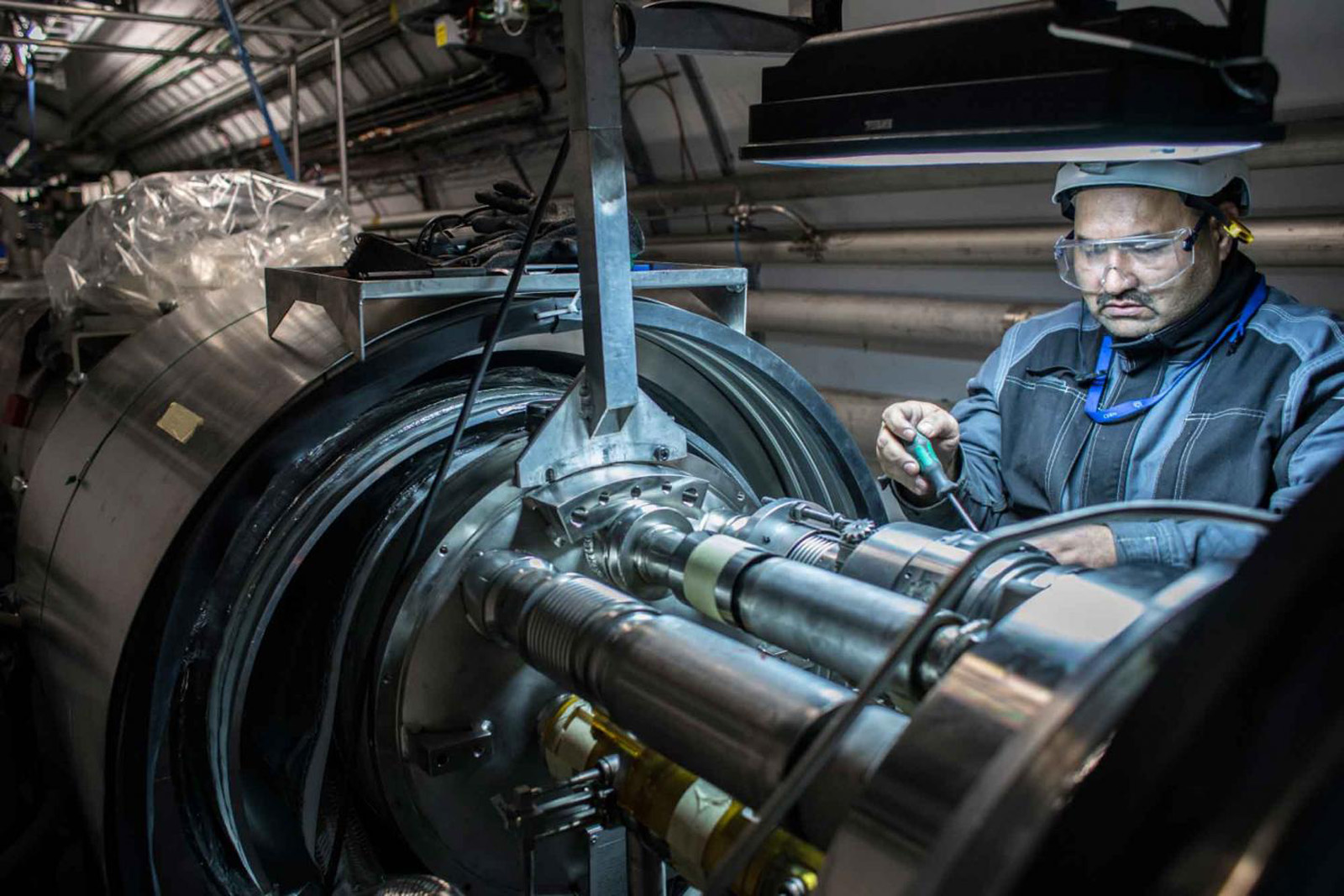

Taking a closer look at LHC
|
"If there's one thing to do, it's to engage in education". George Charpak (Nobel Prize in Physics in 1992). |
|

CERN celebrates 70 years of scientific discovery and innovation.

Large Hadron Collider is the world’s highest energy particle accelerator. LHC (situated in the northwest suburbs of Geneva on the Franco–Swiss border) generates the greatest amount of information that has ever been produced in an experiment before. It is aimed to reveling some of the most fundamental secrets of nature.

Despite the enormous amount of information available about this topic, it is not easy for non-specialists to know where the data come from.
Basically, the purpose of this Website is to help introducing and informing the wider public about the LHC experiment, and some simple physical calculations which take place in all particle accelerators. They can also be used in secondary school classrooms, and, to a lesser extent, to primary school pupils and teachers. in order to stimulate the curiosity of the students, help them understand the physical concepts of LHC, and they can also be used as an example of the relationship between the cold equations of Physics on the blackboard and the exciting scientific research.
Through several sections and many sub-sections (CERN, LHC, PHYSICS at the LHC, Detectors, Standard Model, Education, Links, News ... ) we approach the contents that we believe should be known by non-specialists who are interested in Particle Physics, CERN and the LHC.
It is important to point out that the calculations that appear on this website are adapted to secondary school level, and in most cases, although they may be useful, they are simply approximations of the correct results.
We also present below some of the most recent news items (which we believe to be relevant to the purpose of our website) that feature CERN, and the LHC in particular. In the News section section you will find news from previous years.
This Website has received the permissión of CERN to use informations, data, texts and images from CERN websites. The use on this Website of the various materials from publications produced by CERN is strictly in accordance with CERN's terms of use.
The rest of images, graphs, etc., not belonging to the authors of this website, have been taken as "fair use" qualification, but, please, let us know if that is not the case, and they will be removed immediately.

We show below some facts that are of special relevance, appearing in the different Sections of this website the development of the concepts and contents that we consider to be of interest.
If you are not familiar with the basic concepts of particle physics, we recommend that you first visit the different sections of the general menu of our website.
In the Referencias Section you can find many articles and books dealing with different aspects of Particle Physics, CERN and the LHC. In addition, in this other Section you can consult the articles that the authors of this website have published on these issues with an essentially outreaching intention.
We also present below some of the most recent news items (which we believe to be relevant to the purpose of our website) that feature CERN, and the LHC in particular. In the More News section you will find news from previous years.
CERN highlights en 2024
Tomado de CERN WEBSITE
Run 3
Year 2022, starts LHC Run 3 after a vast programme of works completed during Long Shutdown 2 (LS2). Protons collide at higher energies (13.6 TeV compared to 13 TeV) and with higher luminosities (containing up to 1.8 × 10¹¹ protons per bunch compared to 1.3–1.4 × 10¹¹ ) than in Run 2.
This third experimental phase runs until the end of 2025.
A few weeks after the start of Run3, several records were already reached.
Some of these are:
.- energy with Pb ions: 6.8 Z TeV (or 2.76 TeV/nucleon)
.- peak luminosity: 2.5·1034
.- pile-up (almost simultaneous collision points) > 100
.- stored energy per beam: ~ 400 MJ
Current schedule foresees Long Shutdown 3 (LS3) to start in 2026, one year later than in the previous schedule, and to last for three instead of 2.5 years (taken from CERN Courier).
Energy
In 2012 protons at LHC were running with a beam energy of 4 TeV per proton (8 TeV in collision). At the beginning of 2013, the LHC collided protons with lead ions before going into a long maintenance stop (LS1) until the end of 2014. Running was resumed in 2015 with increased collision 6,5 TeV per proton (13 TeV in collision) and another increase in luminosity. Its maximum total energy of 14 TeV is very close, and after the Long Shutdown 2 (LS2) (2019-2022), in Run 3, an energy of 6,8 TeV per proton (13,6 TeV in collision) has been already reached (very close to the designed maximum initial energy, 7 TeV per proton)
Higgs Boson
One of its main goal has already been achieved in the first phase of operation: to find the Higgs boson.
The Nobel prize in Physics 2013 was awarded to François Englert and Peter W. Higgs "for the theoretical discovery of a mechanism that contributes to our understanding of the origin of mass of subatomic particles, and which recently was confirmed through the discovery of the predicted fundamental particle, by the ATLAS and CMS experiments at CERN's Large Hadron Collider."
The ATLAS and CMS collaborations announced their discovery of the particle at CERN on 4 July 2012. This result was further elucidated in 2013.

Candidate Higgs Decay to four muons recorded by ATLAS in 2012 (Image: ATLAS/CERN).
Interesting articles about the Higgs Boson on the tenth anniversary of its discovery are the following:
https://arxiv.org/abs/2207.
https://www.nature.com/articles/d41586-022-01819-4
|
R E C E N T N E W S We present here some of the most recent and interesting news, according to our criteria, about Particle Physics that have CERN (and the LHC, in particular) as a protagonist. |
IGFAE (Galicia -Spain): construction of a prototype for FCC (CERN).
Jun 2026
Instituto Galego de Física de Altas Enerxías (IGFAE), joint center of the USC and the Xunta de Galicia (Spain), aims to coordinate the construction of the prototype of an essential part for the FCC, the Future Circular Collider of CERN.
In order to design and test all the components of the first phase of the future FCC, the construction of a 43-meter-long mock-up is planned, in which the prototypes to be developed in the respective countries involved in the project will be assembled. When the FCC is built, this mock-up, conceived as a basic unit called an arc cell, will have to be replicated up to 2,000 times until the entire circumference is completed.

Artistic Representation of (Image CERN)
Each of these cells will contain dipole magnets to bend the particle beam, as well as quadrupole and sextupole magnets that focus and defocus this beam. The latter are contained in a subunit called the Short Straight Section (SSS), which is the specific subject of this proposal. For this purpose, a test bench with a full-scale design will be developed, which will be assembled and commissioned at the facilities of the IGFAE itself, and later validated at CERN.
ATLAS observes new composite particle.
May 2026
The ATLAS Collaboration reports the first observation of the Bc*+ meson, an excited counterpart of a particle made up of a charm quark and a bottom antiquark

Artist’s impression of the Bc*+ meson. (Image: Daniel Dominguez/CERN).
This particle is an excited version of the Bc+ meson – both consist of a charm quark and a bottom antiquark – and brings the number of new particles discovered at the Large Hadron Collider to 82.
Studying this particle may provide a deeper understanding of the strong force – one of the four fundamental forces of the Standard Model of particle physics.
The CERN Council decided to update the European Strategy for Particle Physics
May 2026
The CERN Council updated the European Strategy for Particle Physics, which sets out an ambitious scientific vision for the field. The 2026 Strategy update offers a clear path to maintain European leadership in high-energy physics while attracting global collaboration to CERN, advancing technology and bringing many potential benefits to society. The recommendations address a broad range of topics and goals relating to research in high-energy physics in Europe and beyond.
The Strategy recommendations confirmed that the full exploitation of the scientific potential of the LHC through the completion of its high-luminosity upgrades remains the highest medium-term priority for European particle physics. For the longer term, the electron–positron Future Circular Collider (FCC-ee) was recommended as the preferred option for the next flagship project at CERN, thereby maintaining Europe’s leadership in the field.

Artistic representation of the Future Circular Collider (FCC-ee) (Image: CERN)
The FCC-ee would offer the broadest exploratory programme in fundamental physics, with outstanding discovery potential. It would provide a visionary physics programme addressing many of the open questions in particle physics, notably about the Higgs boson, that are critical to understanding the foundations of the Standard Model and opening up opportunities for discovering new physics beyond the Standard Model. At the same time, the FCC-ee would drive the development of new technologies and train thousands of early-career scientists, engineers and technicians.
IGFAE (Santiago de Compostela University) Joins CERN’s CMS Experiment.
April 2026
The Galician Institute of High Energy Physics (IGFAE) has officially joined the Compact Muon Solenoid (CMS) experiment at CERN, marking a major milestone for Galician science. By joining one of the world’s largest scientific collaborations, the institute ensures its researchers will remain at the forefront of the Large Hadron Collider (LHC) through the 2040s. The CMS detector, famous for the discovery of the Higgs boson, provides a long-term platform for investigating the fundamental laws of the universe.

Led by researcher Xabier Cid Vidal, the IGFAE team will contribute both scientific expertise and technical innovation to the project. The institute’s work will focus on searching for dark matter and "long-lived particles," while providing critical support in real-time computing and trigger systems. These systems are essential for processing the millions of particle collisions that occur every second within the detector.
This partnership builds on IGFAE’s decades of experience at CERN and opens new doors for attracting international talent to Galicia. By integrating into the CMS experiment, the institute solidifies its role in global physics, offering local researchers the opportunity to lead discoveries in areas ranging from machine learning applications to the study of the universe's most elusive particles.
Further information for the month of April.
BASE experiment at CERN succeeds in transporting antimatter
The experiment successfully transported a trap filled with antiprotons across CERN’s main site, a remarkable first step towards delivering antimatter to other European laboratories
CMS strengthens the case for toponium
A new independent measurement by the CMS experiment at the LHC is consistent with the existence of the most massive composite particle ever observed, the momentary union of a top quark and its antiquark
What's inside quarks? CMS looks deeper
CMS probes the inside of quarks down to distances of 10–20 m – smaller than ever before – searching for potential more fundamental building blocks within them. It can be excluded structures with sizes of order 10–20 m within quarks.
The Standard Model withstands: new analyses of B meson decays underpin the theory
LHCb finds new hints of possible Standard Model deviations
The LHCb experiment finds intriguing anomalies in the way some particles decay
ATLAS acts as a cosmic-ray laboratory
The ATLAS Collaboration reports its first measurement of proton–oxygen collisions at the LHC, which recreate cosmic-ray interactions with Earth’s atmosphere
ATLAS sets record limits on Higgs boson’s self-interaction
The result is based on over 300 inverse femtobarns of proton–proton collision data, which is equivalent to 30 000 trillion collisions
ALICE sees new sign of primordial plasma in proton collisions.
Mars 2026
The ALICE Collaboration takes a step further in addressing the question of whether a quark–gluon plasma can be formed in proton–proton and proton–nucleus collisions.
A Colaboración ALICE dá un paso máis na análise da cuestión de se pode formarse un plasma de quarks e gluones en colisións protón-protón e protón-núcleo.

A proton–proton collision at the LHC in which many particles were created and tracked by the ALICE detector (Image: ALICE/CERN).
In its new study, the ALICE Collaboration measured the anisotropic flow of multiple meson and baryon species produced in proton–proton and proton–lead collisions, by carefully isolating the particles that were genuinely flowing together.
LHCb Collaboration discovers new proton-like particle.
Mars 2026
Composed of two charm quarks and one down quark, the doubly charmed particle is four times heavier than a proton.

Imaxe CERN
The result will help theorists test models of quantum chromodynamics, the theory of the strong force that binds quarks into not only conventional baryons and mesons but also more exotic hadrons such as tetraquarks and pentaquarks.
NA62 Collaboration refines measurement of rare particle decay.
Mars 2026
The NA62 Collaboration has dramatically reduced the uncertainty in its measurement of an extremely rare particle decay, in results just presented at the 2026 Conferencia de La Thuile.
The NA62 experiment was designed to study the K+ → π+νν
With the full dataset, the NA62 Collaboration obtained an updated value of the K+→π+νν branching ratio with an uncertainty 40% smaller than before.
With the precision of the current result, the kaon decay appears to occur as predicted by theory and sets powerful constraints on new physics beyond the Standard Model.
HiLumi LHC: full-scale tests start.
Feb 2026
CERN has reached a crucial milestone in the advancement of the High-Luminosity Large Hadron Collider (HiLumi LHC) project with the start of the cryogenic cooldown to 1.9 K (‑271.3 °C) of its 95-metre-long test stand – a full-scale replica of the innovative equipment that will transform the LHC in the coming years.

View of the IT String magnet line (Image: CERN)
The test stand is designed to validate the novel magnet system (the inner triplet beam-focusing magnets) and its complex infrastructure, which is a key element in a major upgrade of the LHC that is set to enter operation in 2030.
ATLAS confirms collective nature of quark soup's radial expansion.
January 2026
Scientists analyzing data from heavy ion collisions at the Large Hadron Collider (have new evidence that a pattern of "flow" observed in particles streaming from these collisions reflects those particles' collective behavior. The measurements reveal how the distribution of particles is driven by pressure gradients generated by the extreme conditions in these collisions, which mimic what the universe was like just after the Big Bang.
The research is described in a paper published in Physical Review Letters by the ATLAS Collaboration at the LHC. Scientists from the U.S. Department of Energy's (DOE) Brookhaven National Laboratory and Stony Brook University played leading roles in the analysis.

Simulation QGP (Image CERN)
The new results from ATLAS, while confirming the fluid-like nature of the Quark Gluon Plasma (QGP), also reveal something new because the type of flow studied, 'radial' flow, has a different geometric origin from the 'elliptic' flow studied previously, and it is sensitive to a different type of viscosity in the fluid system.
The ATLAS findings are supported by measurements at ALICE, another LHC experimental detector, which analyzed the same kind of collisions in a complementary way. ALICE has published its results in the same issue of Physical Review Letters.
More here ... and here...
Advancing cancer therapy with next-gen radionuclides.
January 2026
The PRISMAP programme, coordinated by CERN, has supplied 159 radionuclide batches for cancer research over the past five years.

The main objective of PRISMAP – the European medical radionuclides programme, coordinated by CERN – was therefore to provide access to novel, high-purity radionuclides, facilitating the research phase for targeted medical treatments.
ALICE solves mystery of light-nuclei survival.
Dec 2025
Researchers at ALICE studied deuterons (a proton and a neutron bound together) and antideuterons (an antiproton and an antineutron) that were produced in high-energy collisions of protons at the LHC. They found evidence that, rather than emerging directly from the collisions, nearly 90% of the deuterons and antideuterons were created by the nuclear fusion of particles emerging from the collision, with one of their constituent particles coming from the decay of a short-lived particle.

Illustration of how deuterons can be produced from a high-energy collision at the LHC (Image: CERN).
These findings not only explain a long-standing puzzle in nuclear physics but could have far-reaching implications for astrophysics and cosmology. Light nuclei and antinuclei are also produced in interactions between cosmic rays and the interstellar medium, and they may be created in processes involving the dark matter that pervades the Universe. By building reliable models for the production of light nuclei and antinuclei, physicists can better interpret cosmic-ray data and look for possible dark-matter signals.
The ALICE observation provides a solid experimental foundation for modelling light-nuclei formation in space. It shows that most of the light nuclei observed are not created in a single thermal burst, but rather through a sequence of decays and fusions that occur as the system cools.
Deciphering the heavyweights of the tetraquark world.
Dec 2025
To date, the Large Hadron Collider (LHC) at CERN has discovered 80 particles. The LHC’s most striking discoveries is the confirmation of exotic hadrons composed of four or five quarks.
The exact nature of these exotic hadrons is far from established.
In a paper published today in the journal Nature, the CMS collaboration has reported the first measurement of the quantum properties of a family of three “all-charm” tetraquarks.

Illustration of a tetraquark composed of two charm quarks and two charm antiquarks (Image CERN).
... and to know what is coming see HL-LHC: High Luminosity and also The Future Circular Collider.
Professor Mark Thomson selected as the new Director-General of CERN from 2026.
Nov, 2024
The CERN selected British physicist Mark Thomson as the Organization’s next Director-General. The appointment will be formalised at the December session of the Council and Professor Thomson’s five-year mandate will begin on 1 January 2026.

Professor Thomson is currently the Executive Chair of the Science and Technology Facilities Council (STFC) in the United Kingdom and a Professor of Experimental Particle Physics at the University of Cambridge. He has dedicated much of his career to CERN, where he initially contributed to precision measurements of the W and Z bosons in the 1990s, as part of the OPAL experiment at CERN’s Large Electron–Positron Collider. At CERN’s Large Hadron Collider (LHC), he has been a member of the ATLAS collaboration.
Fabiola Gianotti, CERN Director General until the end of 2025.
At its 195th Session (Nov 2019), the CERN Council selected Fabiola Gianotti, as the Organization’s next Director-General, for her second term of office. Gianotti’s new five-year term of office goes from 1 January 2021 to Decembrer 2025.
 (Image CERN)
This was the first time in CERN’s history that a Director-General was appointed for a full second term.
IMPORTANT NOTICE
For the bibliography used when writing each Section in this Website please go to the References Section
We reiterate that the calculations that you will be finding in this Website are adapted from the Physics of Secondary School and in most cases they are just very simple approaches to the correct results.
Besides the Sections of this Website, it may be interesting to take a look at other documents or websites which give simple description of Particle Physics. For example: An Introduction To Particle Physics or A brief introduction to Particle Physics or other ones that you can find in the section Education of this website. Please note that some of these documents or websites are not up to date, but we believe that they still provide good information to get started in particle physics.
We insist that this Website has received the permissión of CERN to use informations, data, texts and images from CERN websites. The use on this Website of the various materials from publications produced by CERN is strictly in accordance with CERN's terms of use.
The rest of images, graphs, etc., not belonging to the authors of this website, have been taken as "fair use" qualification, but, please, let us know if that is not the case, and they will be removed immediately.
A Glossary with an alphabetical list of particle physics terms is included in the last section of this website.
|
AUTHORS Xabier Cid Vidal, PhD in experimental Particle Physics for Santiago University (USC). Research Fellow in experimental Particle Physics at CERN from January 2013 to Decembre 2015. He was until 2022 linked to the Department of Particle Physics of the USC as a "Juan de La Cierva", "Ramon y Cajal" fellow (Spanish Postdoctoral Senior Grants), and Associate Professor. He is currently a Senior Lecturer at the Galician Institute of High Energy Physics (IGFAE) and leads the IGFAE team working on the CMS experiment at CERN.(ORCID). Ramon Cid Manzano, until his retirement in 2020 was secondary school Physics Teacher at IES de SAR (Santiago - Spain), and part-time Lecturer (Profesor Asociado) in Faculty of Education at the University of Santiago (Spain). He has a Degree in Physics and a Degree in Chemistry, and he is PhD for Santiago University (USC) (ORCID). |
CERN CERN Experimental Physics Department CERN and the Environment |
LHC |
IMPORTANT NOTICE
For the bibliography used when writing this Section please go to the References Section
© Xabier Cid Vidal & Ramon Cid - rcid@lhc-closer.es | SANTIAGO (SPAIN) |
